
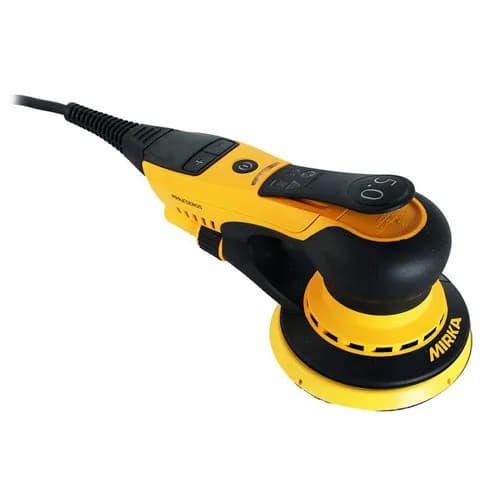
The Mirka DEROS 650 CV is an electric random orbital sander for paint and bodywork. You use it with a 150 mm disc to sand filler, primer and old paint flat, and to level the paint before you polish. The 5 mm orbit gives a precise finish with a light scratch pattern.
Below you will find what the machine does, which sanding discs and abrasive paper go with it, and how to sand step by step without sanding through or leaving scratches. This is how we work with the Mirka random orbital sander.
Mirka DEROS 650CV: the key facts
Item | Detail |
|---|---|
Type | Electric random orbital sander |
Orbit | 5 mm |
Pad size | 150 mm |
Extraction | Low-dust sanding with a connected vacuum (hose and connector Ø 27/32 mm) |
Use | Paint and bodywork, preparation before polishing |
Mirka builds the machine for ergonomic, low-dust work. With the right backing pad for net discs and a vacuum connected, the sanding dust is pulled away right at the surface.
How to sand with the Mirka DEROS 650CV
Choose grit and disc. For filler and old paint you start coarse, for example with Mirka Abranet Ace P150 and then P180 to refine. Tip: do not skip big jumps in grit, because a step that is too coarse leaves deep scratches the next grit will not remove.
Connect the extraction. Hook the machine up to a workshop vacuum such as the Flex VC 21 L MC, which switches on with your machine through its socket. Tip: check that the hose and connector fit your vacuum before you start, so the holes in the net disc stay clear.
Set the machine down flat. Let the disc rest on the panel first and only then switch on. Keeping the machine flat sands the whole disc evenly and prevents a sloped edge in the paint.
Work in overlapping passes. Move the machine slowly across the panel in passes that overlap by half, first lengthways and then across. Tip: do not push extra. The weight of the machine is enough, and too much pressure builds heat and deeper scratches.
Treat edges and curves gently. On edges, corners and body lines you sand with little pressure and use the machine briefly. For curved surfaces there is an interface pad for the 150 mm disc. Tip: feel with your hand whether the paint is flat before you move to a finer grit.
Finish with a fine grit. End with Mirka Abranet Ace P1000 as the last step before machine polishing. Tip: wipe the panel clean between grits so you do not carry coarse dust into the next step.
Common mistakes and tips
Too much pressure. The machine works best on its own weight. Let the abrasive do the work.
Sanding at an angle. If the disc is not flat, you sand with one side of it and end up with an uneven surface.
Wrong grit order. Go step by step from coarse to fine so each grit removes the marks of the previous one.
Leaving dust behind. A full bag or clogged filter lowers the extraction. Empty or replace it in time.
Not checking edges. Paint is thin at corners and lines. Look more often, sand for less time and use a finer grit there.
Polishing afterwards. Once the paint is flat and finely sanded, polishing removes the sanding marks. Read polishing your car and removing swirls or choose a machine with our guide to the best polisher for beginners.
What to combine with the DEROS 650CV
For finer work: Mirka Abralon P2000 and P3000. These are flexible foam pads for wet and dry sanding, handy for orange peel or light imperfections just before polishing.
For workshop dust extraction: the Rupes S130L, a quiet vacuum with a class L filter for sanding and polishing dust.
For small spots: dust nibs and runs come out with a short, targeted approach. Read removing dust nibs and runs from paint.
For headlights: the DEROS is too big for small curved parts. There you work with a pad and by hand, as in polishing headlights.