
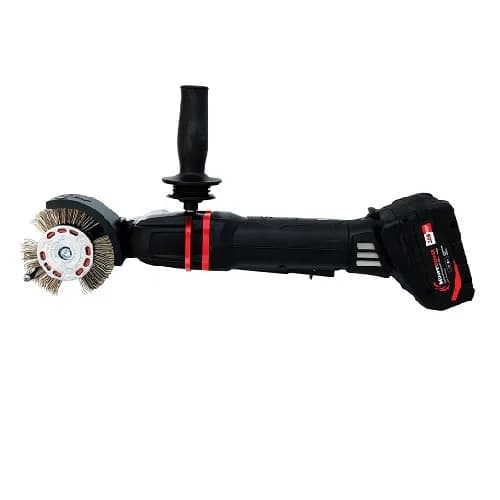
The Monti Bristle Blaster Cordless is a battery-powered tool that strips rust, old paint and mill scale from metal and gives the surface a rough anchor profile for the new coating. If you want a rust removal machine for local spots, weld seams or hard-to-reach areas, the bristle blaster is a logical choice: no power cable, no compressed air and no blasting media.
We use it as the first step in rust repair. First get the metal bare and keyed, then protect it straight away. This guide explains how the Monti Bristle Blaster works, how to use it step by step and what to watch for.
What is the Monti Bristle Blaster Cordless?
The tool spins a belt of forward-curved, hardened steel wire bristles. An accelerator bar holds the bristles back and releases them, so the tips strike the metal instead of rubbing across it. Each impact removes corrosion and leaves a tiny crater. That produces the rough profile that paint and primer grip onto. The battery is included, so you can get to work straight away.
Feature | Detail |
|---|---|
Type | Cordless bristle blasting tool |
Power | Battery included |
Use | Rust removal, coating removal, weld seam preparation |
Suitable for | Metal, plastic, rubber |
Anchor profile | Depends on steel type, rust grade, belt and technique |
Segment | Automotive, marine, industrial maintenance |
How to use the Bristle Blaster step by step
Workspace and protection. Take the car or part to a spot with extraction and wear safety glasses, gloves and a good mask, such as a Sundstrom SR900 half mask. Media-free does not mean dust-free: loosened rust and old paint still end up in the air. A pair of COLAD nitrile gloves keeps your hands clean.
Mask off the area. Tape off paint, rubbers and glass nearby. The belt works locally and precisely, but loosened rust particles and paint flakes travel further than you think.
Check the belt and battery. Use only original Monti belts and a full battery. Replace a damaged belt straight away, because it gives an uneven result.
Make a test strip. Start on an area that will be treated anyway and see what the belt does. The result depends on steel type, rust grade, belt and technique, so check the result rather than assume it.
Work evenly. Let the belt do the work with calm, overlapping passes. Pressing too hard slows the bristles and gives a less even profile. Take extra care on weld seams and edges.
Clean and degrease. Wipe or vacuum away all dust and degrease the bare metal. Bare steel starts rusting again quickly in damp air, so finish the job the same day.
Protect straight away. Put a primer on the bare steel, for example Bilt Hamber Electrox Zinc Primer. For an etch and weld-through layer, reach for Bilt Hamber etchweld.
Common mistakes and tips
Skipping preparation: remove coarse dirt, grease and loose flakes first and the belt stays sharp for longer.
Staying too long in one spot: work in overlapping passes so the profile is even everywhere.
Using non-original belts: this gives a worse result and puts more strain on the tool.
Leaving the bare steel unprotected: prime it the same day or the rust comes back.
Leaving flammable items nearby: remove them and keep solvent vapours out of the workspace.
Spots the belt cannot reach: treat these with a rust converter first, as described in our guide on removing rust from your car.
What to combine the Bristle Blaster with
After blasting you have bare, rough metal. You want to cover it with a system that suits the spot. For weld seams and bare parts a zinc-rich primer makes sense, as described in our guide to the Electrox zinc primer. For remaining rust you cannot reach, use Bilt Hamber Hydrate 80. You can read how it works in the guide using Hydrate 80.
For an underbody that is rust-free, plan the whole package: see rust prevention and underbody protection. More tools are in the category tools and machines, protective products in rust prevention and preservation. For masks and protective gear see PPE and safety.