
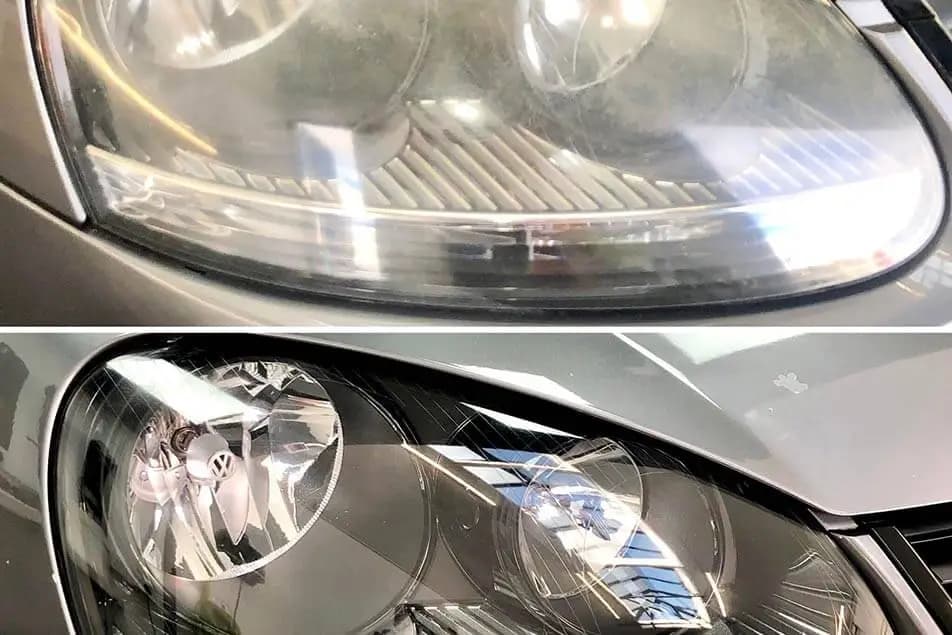
Polishing headlights comes down to four parts: masking, wet sanding with ever finer grits, polishing and sealing with a protective layer. If the lens is only slightly dull you can skip the sanding and use a kit or a cleaner with sealant. Leave out the protective layer and the yellowing comes back sooner.
Dull headlights happen because sunlight breaks down the outer layer of the plastic lens. The lens turns matt and yellow and you see less in the dark. With headlight restoration you remove that weathered layer and put a fresh protective layer on top. You need only a few products and no new headlights.
Restoring dull headlights: which approach suits your lens
Condition | Approach | What you use |
|---|---|---|
Slightly dull, smooth to the touch | Clean and add a protective layer | |
Dull and starting to yellow | Complete kit: clean, polish, seal | |
Heavily yellowed or rough | Wet sand from P1000 to finer, then machine polish | Mirka Abralon Sanding Pad P1000 and Koch Chemie Headlight Polish 1 |
Haze on the inside | Polishing will not help, because the haze sits behind the glass | Have the headlight checked |
If you only see a light haze, always start with the mildest approach. A kit works entirely by hand: clean, polish and seal, no machine needed. If the lens has deep scratches or a yellow, rough top layer, only sanding and machine polishing will take it off.
How to do it
Clean and mask. Wash the headlight, dry it properly and mask the surrounding paint, rubber seals and the bumper edge generously with masking tape. Pitfall: one pass of sandpaper next to the lens and you are through the paint.
Wet sand in stages. If the lens is heavily yellowed, start with P1000 and work through P2000 to P3000. The Mirka Abralon pad can be used wet or dry, and the flexible foam follows the curve of the lens. Sand in a crosshatch pattern and keep the surface wet. Tip: only move to the next grit when the lens is evenly matt all over, otherwise deep scratches stay behind. With a lightly dull lens you skip this step.
Polish. With a machine you use Koch Chemie Headlight Polish 1 on a heavy cut pad or lambswool pad, at medium speed and medium pressure, in crosswise passes. It removes sanding marks up to roughly P1000. For tight corners the Krauss Micro Pad Wool fits on an M14 machine. Pitfall: a lens heats up quickly. Work in small sections and keep moving, as Koch Chemie says the surface temperature should not exceed 40 to 45 degrees Celsius. With the Turtle Wax kit you polish by hand following the instructions in the box.
Wipe clean. Remove all polish residue with a clean microfibre cloth.
Seal. This is the step that delays yellowing. The Turtle Wax kit finishes with a sealant, and the Turtle Wax Headlight Cleaner & Sealant cleans and protects in one bottle. Tip: work in the shade and let the layer cure as stated on the packaging before the car goes out in the rain.
Check in daylight. Look at the lens from a low angle. If you still see sanding scratches, go back one grit and polish again. Then remove the tape.
Which kit or product to choose
You want little fuss and no machine: the Turtle Wax kit. You can use it on headlights and tail lights.
Maintenance or a light haze: the 300 ml Turtle Wax Headlight Cleaner & Sealant, applied with a clean cloth. On heavily yellowed lenses you combine it with the kit.
Plenty of yellowing and you own a polisher: sand with Mirka Abralon (P1000, P2000 and P3000 are all available) and polish with Koch Chemie Headlight Polish 1.
Small or awkward headlights: the 15 mm Krauss Micro Pad Wool reaches corners where a large pad cannot.
You will find more polishes and compounds in our polish and compound category. Sanding pads and discs are under sanding discs and paper.
How to keep your headlights clear for longer
How long the result lasts depends on how much sun the car gets and how old the lens is. You help the protective layer by parking in the shade or a garage more often and washing the lens along with the car. If you also want to protect the paint around it, read our guide on choosing wax, sealant or ceramic coating.
Using a polisher for the first time? In polishing your car and removing swirls you can read how to hold a machine and how much pressure to use. If your paint is dull too, our overview of the best car polish will help.