
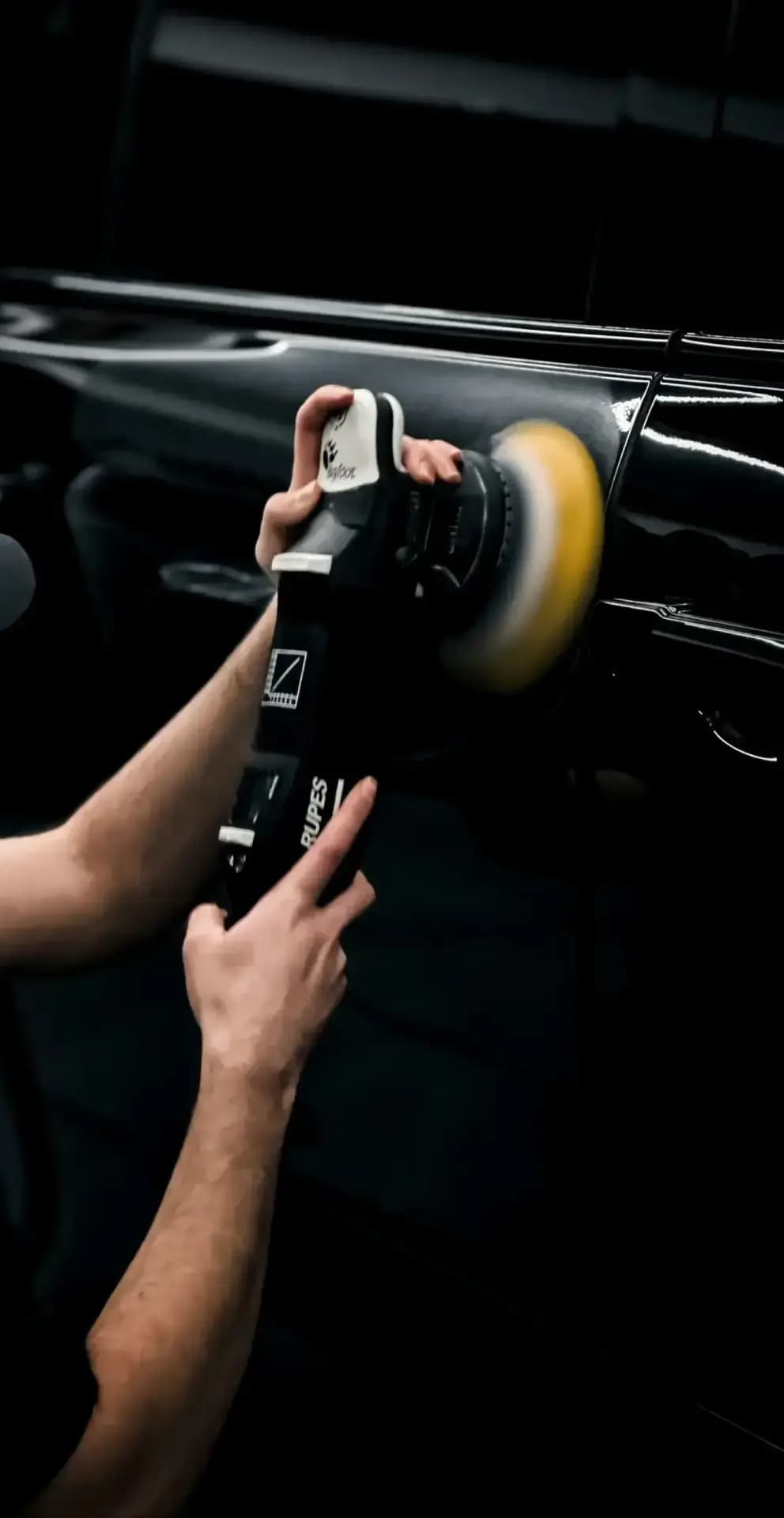
Polishing removes swirls and light scratches by levelling a wafer-thin layer of the top coat (the clear coat) until the scratch disappears. The golden rule: start with the least aggressive pad and polish, make a test spot first and work in sections of 60 by 60 centimetres. With the D-CON Delta Pro polishing pads on a dual-action machine you can do this safely, even as a beginner.
Why polishing works (and why to be careful)
Swirls and marring are tiny scratches in the clear coat that scatter light in all directions, making the paint look dull. A polish with a pad removes a minute layer of clear coat until the surface is flat again and reflects light cleanly. That clear coat is finite: you cannot polish forever. Always work as lightly as possible and only where needed.
How to use it
Prepare. Wash and degrease the car, clay the paint for a smooth surface and tape off vulnerable parts: rubber, plastic and trim. Keep the car out of the sun and let it cool down.
Make a test spot and pick the least aggressive combination. For light swirls, polish in a single step with a soft finishing pad; for deeper scratches, start with a firmer cutting pad and finish with a softer pad.
Work in sections of 60 by 60 centimetres. Lightly dampen the pad, apply a few small drops of polish, spread on low speed and then increase (dual-action setting 3 to 6) in a cross pattern from horizontal to vertical, until the polish is almost transparent.
Wipe clean with a fresh microfiber cloth and check the result with an LED lamp at an angle. Repeat with a finer pad and polish for the finish if needed, and clean the pad after each section.
One, two or three steps: how much correction?
Light swirls are handled in a single step with a finishing pad and a fine polish. Medium scratches take two steps: correct first with a medium pad and compound, then finish with a finishing pad. Heavy damage needs three steps: start with a wool pad and a strong compound, then follow the two-step procedure. If you cannot get there yourself, leave heavy correction to a professional.
Mind the paint type
Not every paint is equally hard. Japanese brands like Toyota, Honda and Mazda often have soft paint: start gently with a finishing pad, especially on black. German brands like VW, BMW and Mercedes have harder paint that takes more pressure and speed, and Audi and VW are known for an extra hard factory clear coat. Dark colours show faults faster than light ones. So always make a test spot first and work softer when in doubt.
Common mistakes
Starting straight away with the most aggressive pad. Always start light and build up only if needed.
Not watching the paint temperature. Warm paint and dwelling too long in one spot increase the risk of damage.
Not cleaning the pad between sections, or using too much polish. A saturated pad works worse and unpredictably.
Polishing too often. The clear coat is finite, so only polish where and when it is really needed.