
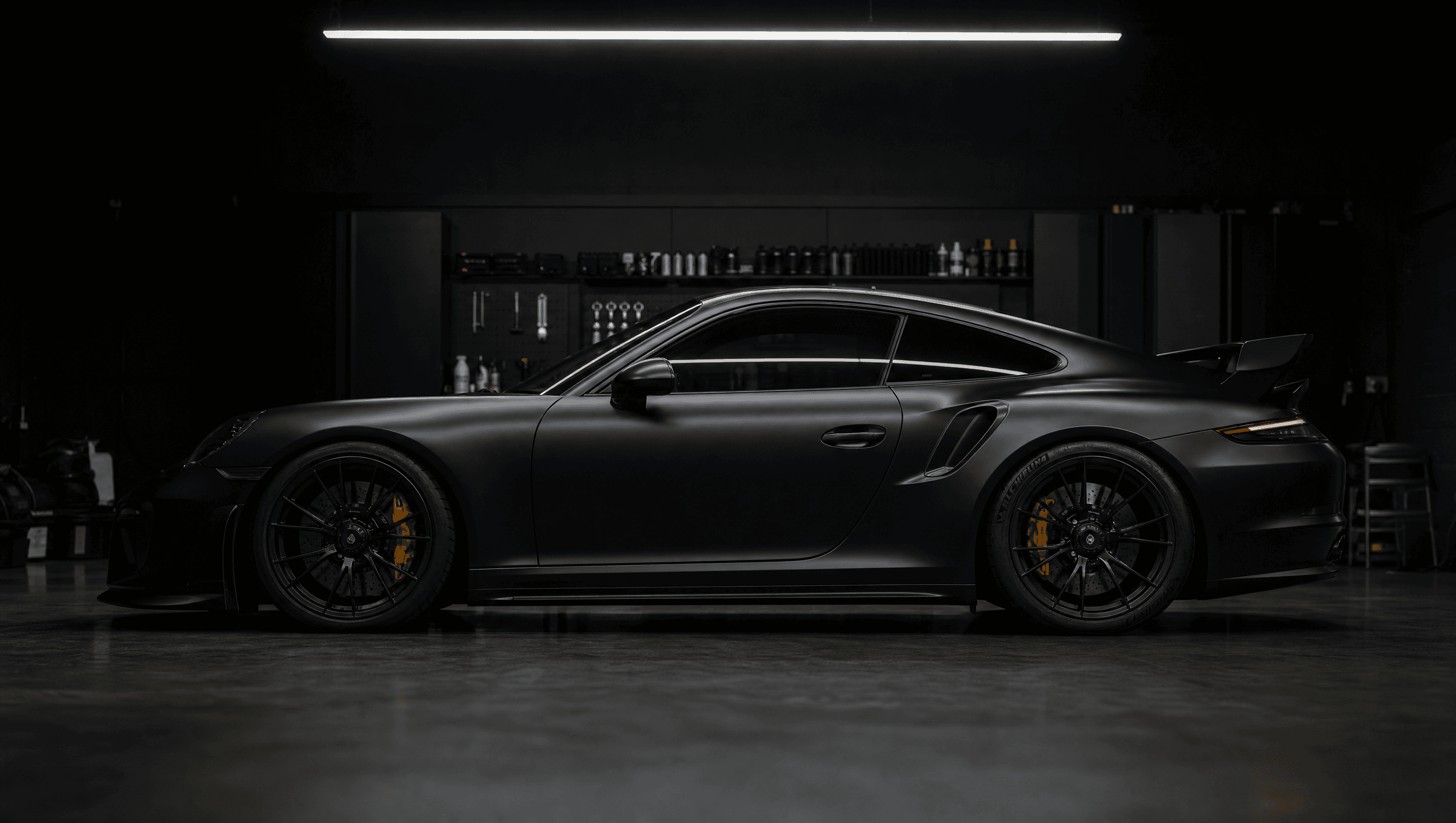
Applying ceramic coating yourself involves six steps: wash, decontaminate, polish, degrease, apply the coating, and let it cure. Preparation is the determining factor. A coating applied to a contaminated or damaged paint surface permanently locks those imperfections underneath the coating layer.
When done correctly, the result is a hydrophobic, UV-resistant protective layer that lasts one to two years for consumer coatings and three to five years for professionally applied ones. Set aside a full day. Rushing is the single biggest enemy of a good ceramic coating job.
Quick facts
Time: 6-8 hours including preparation
Difficulty: Advanced
Material cost: from ~€50
What you need
Make sure everything is ready before you start. Stopping halfway to find materials costs you time and quality.
Car shampoo, microfibre wash mitt, two buckets with grit guards
Iron remover and clay bar with lubricant
Dual-action polishing machine, cutting pad, finishing pad, medium compound and fine polish
Panel wipe or 99% isopropyl alcohol as degreaser (not 70%; it contains too much water and harms adhesion)
Ceramic coating, suede applicator with foam block, clean microfibre cloths
Good lighting: work lamp or LED bar to spot high spots and swirls
How to use it
Thorough wash. Start with a two-bucket wash. Use a microfibre wash mitt, not a sponge. A sponge holds dirt and drags it across the paint, causing fine scratches. Work top to bottom in straight lines, never in circles. Circular movements are the direct cause of swirl patterns that you will have to polish out in step 3. Rinse each panel immediately before the dirt dries. Dry the car afterwards with a clean microfibre drying towel, using gentle pressing movements rather than rubbing. Pitfall: if your shampoo contains wax, the coating will not bond properly later. Always use a wax-free shampoo.
Decontamination. After washing, there are almost always iron particles and tar deposits embedded in the paint that you cannot see but can feel. Spray an iron remover onto a clean, lightly damp panel out of the sun and wait until the liquid changes colour from clear to purple-red. Do not work on a soaking-wet panel, as that dilutes the product and weakens it. That colour change is iron oxidation, coming from brake dust embedded in the paint. Rinse thoroughly. Then work the clay bar with lubricant over every panel until the surface feels smooth, like glass. This removes organic contamination and tree sap that the iron remover does not tackle. Dry the car again before moving to step 3. Pitfall: never use a clay bar without lubricant. Dry claying pulls scratches into the paint that cost you extra work during polishing.
Polishing. Polishing is the most time-consuming step and also the most critical. Ceramic coating is transparent and locks the paint in exactly the state it is in. Swirls, holograms or oxidation will not disappear after application. Start with a cutting pad and medium compound on the dual-action machine at a medium speed, roughly 60 to 70 percent of your machine's maximum (speed scales differ per brand). Work panel by panel in sections of 40 by 40 centimetres: four horizontal passes, four vertical passes, then wipe off. Check with your work lamp from a sharp angle. Then switch to a finishing pad with fine polish to build gloss. Pitfall: too much product on the pad creates haze instead of gloss. Use three to four drops of compound each time, no more.
Degreasing with panel wipe. After polishing, a thin layer of polish residue remains on the paint. This must be removed completely before the coating goes on. Apply panel wipe or 99% isopropyl alcohol (90% minimum) to a clean microfibre cloth and wipe each panel in straight passes. Check the cloth: if it comes away dark, the panel was not yet clean. Use a fresh, clean cloth for a second pass. Panel wipe also removes oil residue that would prevent adhesion. It does not fully remove wax; if the paint was waxed recently, wash first with a wax-stripping shampoo. Pitfall: always wear nitrile gloves during and after the degreasing phase. Skin oil from your fingers is enough to leave a grease spot the coating cannot bridge.
Applying the ceramic coating. Apply the coating at a temperature between 15 and 25 degrees Celsius and a relative humidity below 70 percent. Working outdoors in direct sunlight is not an option. Work in an enclosed space or in the shade. Drop four to six drops of coating onto the suede applicator and work in panels of no more than 50 by 50 centimetres. Move the applicator in a cross pattern: horizontal passes, then vertical passes over the same area. Wait until the coating shows a rainbow or haze effect; that is the most reliable indicator. The flash time depends heavily on temperature and humidity, so treat the time on the data sheet only as a guideline. Then wipe it off immediately with a clean microfibre cloth and buff away the spots with remaining resistance, the high spots, with a second cloth. Never leave them longer than indicated, as cured high spots are extremely difficult to remove without polishing work. Pitfall: always work panel by panel and wipe off before moving to the next one. Coating two panels and wiping both afterwards is a guaranteed way to end up with baked-in high spots.
Curing. After application, the curing phase begins. The coating is extremely vulnerable to water during the first 24 hours. Rain, dew, bird droppings or sprinkler water landing on the surface while the coating is still curing will pull water spots into the coating layer that cannot be removed without polishing work. Keep the car in a garage or under a solid carport. Do not drive in the rain for the first 24 hours. Full chemical cure takes two to four weeks, depending on the coating and ambient temperature. During this period the coating is still reacting to extreme temperature fluctuations. How strict that first phase is varies enormously between coatings: some sprays and sealants are rain-safe within an hour, while a hard ceramic coating may want up to seven days fully dry. The 24 hours above is a safe rule of thumb, not a law. Always follow the cure time on the data sheet of your specific coating. Pitfall: placing a protective cover directly after application causes condensation that has the same effect as rain. Leave the coating exposed to the air in a dry space for the first 24 hours.
Maintenance after application
Maintaining a ceramic coating is simpler than the paint care required beforehand, but it does demand consistency. After every wash, finish with a pH-neutral quick detailer applied to the still-damp paint. This fills micro-imperfections and keeps the hydrophobic performance at the right level.
After three months, apply a coating topper spray as a booster layer. This significantly extends the lifespan of the coating and is straightforward to apply yourself after a regular wash.
Schedule an annual inspection. Check the hydrophobic performance by running water over the bonnet. Beading water that rolls off in large droplets means the coating is still active. If water spreads into flat patches, a topper layer or a full reapplication is due.
Frequently asked questions
How long does ceramic coating take to fully cure?
Can it rain after ceramic coating is applied?
How many layers of ceramic coating should you apply?
How long does ceramic coating last?
What is the difference between ceramic coating and wax?
Can you apply ceramic coating over wax?
About this guide
Written by T&H Car Care, Borne. We specialise in ceramic coating and paint maintenance for private and business customers across Twente. Prefer to have ceramic coating applied by a professional? View our ceramic coating service for a professional treatment with guarantee.