
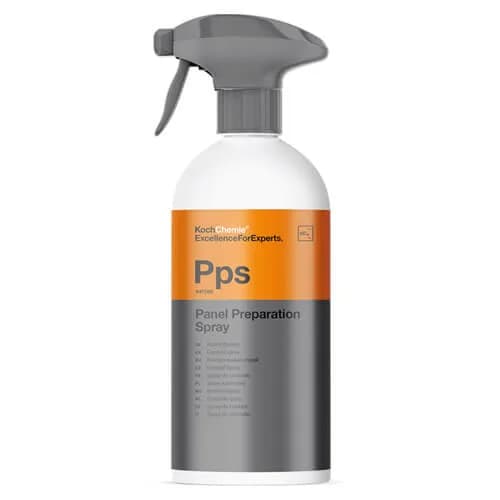
The Koch Chemie PPS Panel Preparation Spray is a ready-to-use panel wipe that removes polish residue, oils and wax from your paint before you apply wax, sealant or coating. You spray it on the panel, wipe it off with a clean, dry microfibre cloth and are left with bare, degreased paint that your protection can bond to properly.
We use Koch Chemie PPS as the last step after polishing. The spray is alcohol based and free of halogenated hydrocarbons. It comes in a 500 ml bottle and needs no dilution. Below you can read when to use it, how to work with it and what to avoid.
Why use a panel wipe after polishing
Polishes leave oils behind. These temporarily fill fine scratches and holograms, so the paint looks better than it really is. Once you go over the panel with panel preparation spray, that layer disappears and you see the true result. If holograms or scratches are still visible, you know the panel needs another polishing pass.
For wax, sealant and coating this matters just as much. Oil or wax residue on the paint can interfere with adhesion, and then the protective layer does not last as long. A degreased surface is the foundation under every coating. You will find more preparation products in the degreasers category.
Koch Chemie PPS: key facts
Property | Detail |
|---|---|
Content | 500 ml |
Type | Degreaser, ready-to-use panel spray |
Base | Alcohol, free of halogenated hydrocarbons |
Suitable for | Solvent-resistant paint, plastic and metal |
Removes | Oils, wax and polish residue |
Purpose | Before applying coating or wax |
How to do it
Wash and decontaminate first. PPS removes oils and residue, not baked-on dirt. Start with clean, clayed paint, as in our guide on claying your car with a clay bar. Tip: never degrease a panel that still carries dust or grit, because you will drag it across the paint.
Polish first. Do not skip polishing if you want to deal with scratches or holograms. PPS is the last step after polishing, not a replacement for it. Tip: wipe away the last polish residue with a clean cloth first.
Work cool and in the shade. Alcohol evaporates quickly. On a warm panel the spray flashes off before you have wiped it. Tip: work panel by panel, so bonnet first, then roof, then doors.
Spray and wipe. Spray the product on the panel and wipe it off straight away with a clean, dry microfibre cloth. Tip: use a soft cloth such as the Bilt Hamber Ultra-Soft microfibre cloth and turn it over regularly.
Check under light. Use a lamp or the sun to see whether holograms or scratches are still visible. Tip: if you can see them, polish that panel again and degrease it once more afterwards.
Protect straight away. Apply wax, sealant or coating as soon as the panel is dry. Tip: do not touch the paint with bare hands afterwards, because fingerprints leave grease behind.
Common mistakes
Spraying too much onto a warm panel, so the spray evaporates before you wipe.
Using a dirty or wet cloth. A little dirt in the fibres leaves streaks and marks.
Forgetting edges, door shuts and the inside of the boot lid, even though the coating goes there too.
Using PPS as a cleaner for caked-on dirt. That needs a wash or a clay treatment first.
Skipping the spray because the paint already looks glossy after polishing. Part of that gloss is polish oil.
Treating a large area of a surface you do not know straight away. Test a small spot first.
What to combine Koch Chemie PPS with
PPS is one link in a routine, so we often name the same combinations. For the protective layer you put down a ceramic coating such as the Koch Chemie CB 0.01 Ceramic Body Coating. Our guide explains how to apply a ceramic coating yourself, and the guide on applying the CB 0.01 goes into more detail.
For the polishing before that, the Koch Chemie Fine Cut Polish F6.01 fits well, a fine polish with an aluminium oxide base. Unsure between wax, sealant or coating? Read wax, sealant or ceramic coating: which to choose. Which cloth suits which job is covered in our guide to microfibre cloths, colour and GSM.