
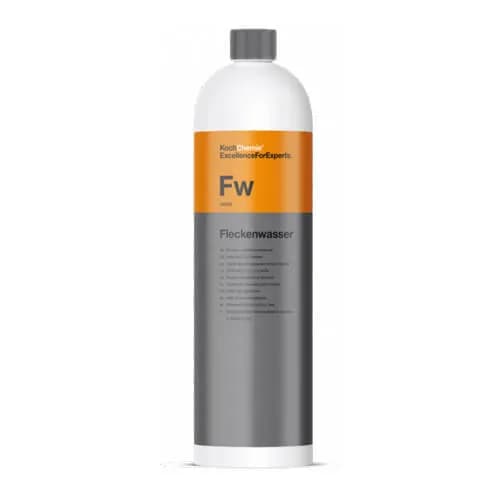
Koch Chemie FW Fleckenwasser Stain Remover 1 L is a stain remover that dissolves grease, oil, ink, paint, paraffin wax residue and tar. You use it neat: a little on a dry, absorbent cloth, then gently rub the stain out. It works on glass, paint, ceramic, metal and solvent-resistant textiles, and it contains no halogenated hydrocarbons.
In the workshop we reach for Koch Chemie FW Fleckenwasser for two jobs in particular. The first is a stain that shampoo or an ordinary interior cleaner leaves behind. The second is taking off old wax residue before a new coating or sealant goes on. One bottle covers both, so it always sits within arm's reach.
What is Fleckenwasser and when do you use it?
Fleckenwasser is a solvent-based cleaner. It dissolves greasy and organic dirt that water and soap leave behind: cosmetics, oil, ink, paint and wax residue. Koch Chemie's formula contains no halogenated hydrocarbons, which makes it a sensible choice for use indoors and in the car.
It does not replace an interior cleaner. For everyday dirt on plastics and upholstery you use a standard cleaner. The stain remover is for the mark that is still visible afterwards.
Key facts about Koch Chemie FW
Property | Details |
|---|---|
Content | 1 L |
Type | Stain and wax remover |
Halogenated hydrocarbons | None |
Suitable for | Glass, paint, ceramic, metal and solvent-resistant textiles |
Dilution | Use neat |
Application | With a dry, absorbent cloth |
How to do it
Test first. Try the stain remover on an inconspicuous spot, such as under the seat or in a door edge. Not every dye or coating reacts the same way to solvents, so this tells you in advance whether the surface stays colourfast.
Remove loose dirt. Vacuum textiles and wipe dust off paint or glass. Otherwise grit and crumbs will scratch under your cloth.
Prepare the cloth. Take a dry, absorbent cloth, for example the Bilt Hamber Ultra-Soft Microfiber Cloth. Put a small amount neat on the cloth, not straight onto the surface. Tip: start with little, you can always add more.
Rub it out. Work from the edge of the stain towards the centre so it does not spread. Rub gently and do not scrub hard, so the fibre structure of textiles stays intact.
Switch to a clean side. Fold the cloth to a clean face as soon as it has picked up dirt. A dirty face puts the stain straight back.
Repeat and finish. If an edge remains, repeat with a clean face. Then clean the interior with a regular cleaner. On paint or glass a wash follows, and after stripping old wax you can add a fresh layer of protection.
What is Fleckenwasser used for?
Grease and oil on glass, paint, ceramic and metal.
Ink and paint on surfaces that can handle solvents.
Tar and paraffin wax residue.
Old wax residue on paint, as preparation for a new coating or sealant.
Stains in solvent-resistant textiles, such as car upholstery or furniture fabric.
Want to know more about cleaning seats and upholstery as a whole? Read our guide on cleaning car seats and upholstery. If the problem is sticker glue, removing stickers and adhesive residue will help you further.
Common mistakes and tips
Too much product. A small amount on the cloth is enough. A dripping cloth spreads the stain rather than lifting it.
Scrubbing hard. Rub calmly. With force you work the stain deeper into the fibre.
Skipping the test. An inconspicuous spot takes a few seconds and prevents a visible difference on the part you care about.
Working in the sun. Work in the shade and on a cool surface instead. That way the solvent does not evaporate too quickly.
Letting the stain spread. Start at the edge and work towards the centre.
What do you combine Fleckenwasser with?
Koch Chemie Eulex M Adhesive & Stain Remover for adhesive, tar and sticker residue on paint, including matt paint. How it works is covered in the guide on using Koch Chemie Eulex.
BrandX X-Tra Fast Carpet & Upholstery Cleaner for ordinary stains on car carpet and upholstery: spray onto the stain and wipe away.
You will find every other interior cleaner in the interior cleaners category.