
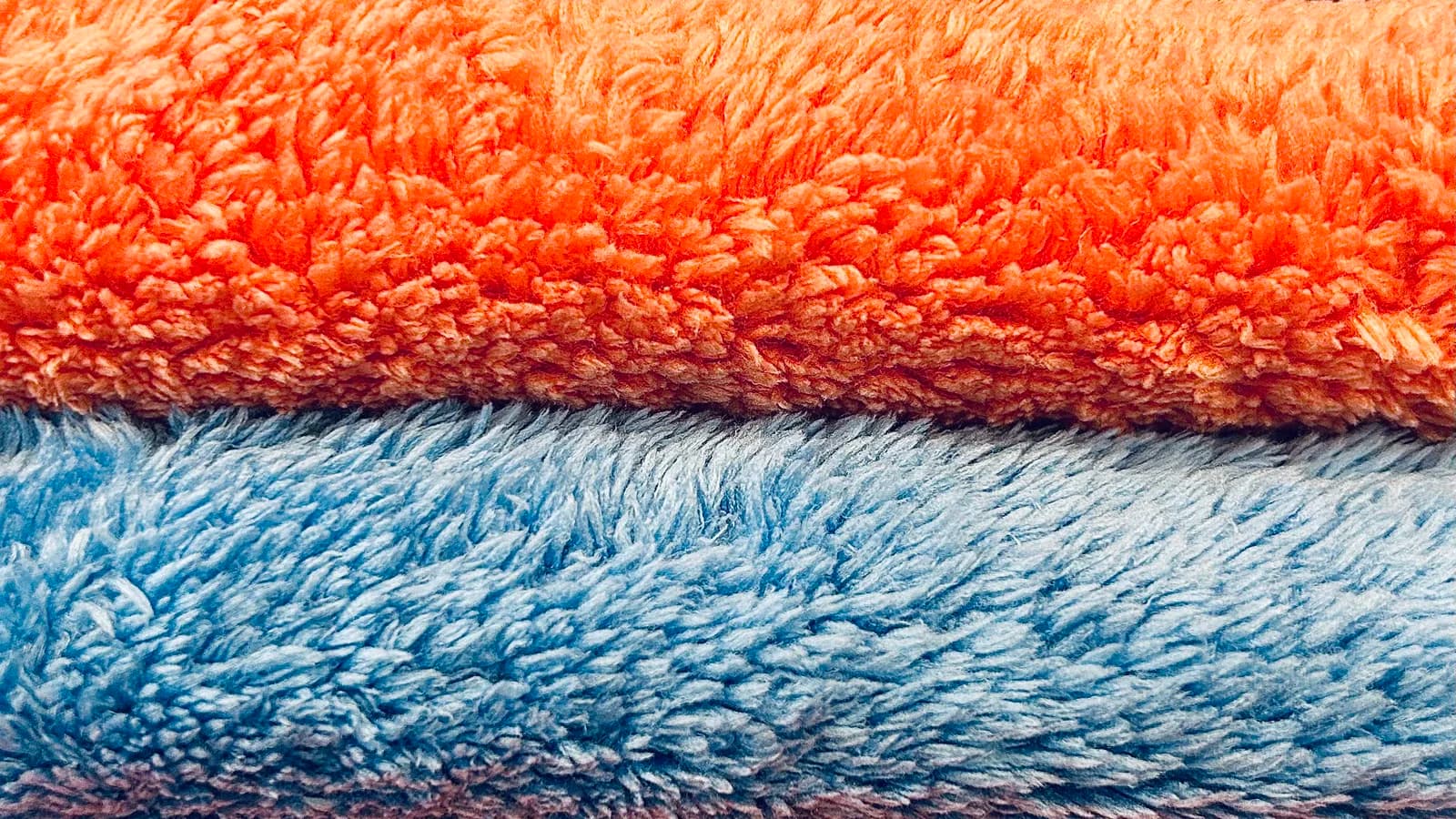
You sort microfibre cloths by colour so you never carry dirt from one part of the car onto another. A cloth that has been near the wheels is full of fine brake dust and grit. Use that same cloth on your paint afterwards and you drag that abrasive across the panel, which gives you exactly the scratches you were trying to avoid. Colour is not a gimmick, it is a system: one colour per zone, and dirt stays where it belongs.
The second thing that matters is weight, written as GSM (grams per square metre). That tells you how thick and soft a cloth is. A heavier cloth holds more water and dirt and glides more softly over the paint, while a lighter cloth is flatter and handier for general work. Below you will find which colour and which weight we reach for on each job, and how to wash your cloths so they last.
Quick facts
Colour sets the zone: one fixed colour per part prevents cross-contamination and scratches.
GSM is the weight: higher (300+) is softer and more absorbent for paint and finishing, lower (around 280) is fine for general work.
Never use fabric softener, never wash with linting cotton, and keep wheel and paint cloths separate in the machine too.
Why you sort cloths by colour
Most of the scratches on a car do not come from polishing, they come from washing and drying. Small particles of dirt act like sandpaper the moment you move them across the paint. The heaviest contamination sits low down: wheels, tyres and door shuts. Carry those particles up to the bonnet or the flanks on a cloth and you draw fine marks that show up as swirls in the sun. Giving each zone its own colour means you can see at a glance which cloth is allowed where. You do not have to think about it, and you never grab the wrong one by mistake.
The colour code we use
This is the system we use at T&H Car Care. It does not have to be exactly this, but it works and it is consistent. Choose your own colours if you like, as long as you follow one rule: a cloth that has touched the dirty zones never goes back on the paint.
Green: the exterior paint. Our heaviest cloths, around 300 GSM, so they move softly over the panel.
Purple: wheels, tyres and door shuts. The dirtiest zones, around 280 GSM. These cloths see the most brake dust and grit.
Blue: windows and mirrors, around 280 GSM. Streak-free work needs a clean, separate cloth.
Yellow: the interior, around 280 GSM. Dashboard, panels and plastics.
Brown: the finishing work after polishing, coating or wax, around 300 GSM. A soft cloth you only use on clean, protected paint.
What GSM tells you
GSM stands for grams per square metre and is simply the weight of the fabric. Around 280 GSM you get a cloth with a short, flat pile. It is firm, dries quickly and is ideal for general work: glass, interior, applying product. From 300 GSM upwards the pile gets thicker and plusher. That cloth holds more water and glides more softly, which is what you want on paint and on a fresh coating. The plushest cloths, around 500 GSM and up, are the softest and so are nice for the most delicate work like bringing paint to a shine. So you do not have to buy the heaviest cloth: the 280 to 300 GSM in our colour system covers most jobs fine. More expensive is not always better, but you do not want a cheap, hard cloth on your paint.
Edges, seams and folding
On paintwork, watch the edges. Many cheap cloths have a hard stitched edge or a sewn-in label, and it is that edge that can draw a scratch while the soft middle does no harm. For paint, use a cloth with a soft banded edge or an edgeless cloth. Fold your cloth into quarters: that gives you eight clean faces, and you turn to a fresh side the moment one gets dirty. Once a cloth is loaded, set it aside and grab a clean one. Carrying on with a dirty cloth is asking for scratches.
Which cloth for which job
In practice it works like this. For drying after the wash you use a separate, thick drying towel that takes up a lot of water at once. During the wash itself the dirt comes off the paint with a wash mitt, not a cloth; the cloths come afterwards. For the windows you reach for a blue cloth with a glass cleaner so you finish streak-free. And for buffing off a fresh coating you use a soft, plush cloth that has not been anywhere else yet; the coating itself goes on with a suede applicator, not with a cloth. That keeps every step clean and your paint scratch-free.
Washing and care
Microfibre lasts a long time if you wash it properly. Never use fabric softener: it lays a film on the fibres so they pick up less water and dirt, which is exactly what you do not want. Wash your cloths separately from cotton and other linting textiles, because that lint stays caught in the pile. Wash at a low temperature, around 40 degrees, and ideally air dry them or use the lowest setting on the dryer. Keep your zones separate in the wash too: wheel cloths with wheel cloths, paint cloths with paint cloths. A wheel cloth full of iron particles in the same wash as your paint cloths will contaminate them anyway.
Frequently asked questions
Why can't I use fabric softener on microfibre?
How often should I replace a microfibre cloth?
Can microfibre cloths go in the washing machine and dryer?
Does the colour really matter or is it marketing?
Which cloth do I use for buffing off a coating?
Can't I just use one cloth for everything?
See also
About this guide
This guide comes from T&H Car Care, a detailing business in Borne, the Netherlands. We wash and detail cars ourselves, so this is the system we use in daily practice, not something out of a brochure. Questions about cloths or about your own approach? You are welcome to drop by.