
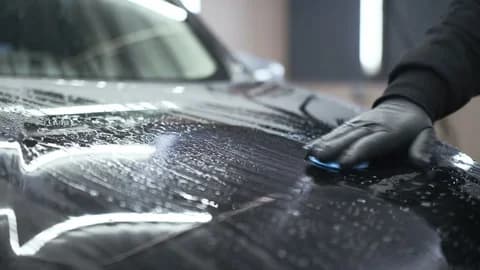
To clay bar your car, you glide a clay bar, clay towel or clay mitt over freshly washed paint with plenty of lubricant, so bonded dirt comes off the surface. You do it after washing and before polishing or waxing. A clay bar picks up what shampoo leaves behind: brake dust, flying rust, tar, tree sap and industrial fallout. Afterwards the paint feels as smooth as glass, and wax, sealant or coating bonds better.
In our workshop, claying is a fixed step before we polish a car or give it a protective layer. Below you can read when to clay, which form of clay suits you and how to do it in six steps.
What does a clay bar do to your paint?
Washing removes loose dirt. Particles that have embedded themselves in the paint, such as metal particles from brake discs and railway lines, tar and overspray, are still there after the wash. Clay is a soft material that picks up these particles as it glides over wet paint. So it works differently from a polish: it lifts dirt off instead of grinding paint away. That is why you always work with a lubricating layer and fold the clay to keep a clean face.
When should you clay? The plastic bag test
Wash and dry the car. Put your hand in a thin plastic bag (a sandwich bag works well) and run your fingertips over the paint. The bag sharpens your sense of touch. If it feels rough or gritty, particles are stuck in the paint and claying is the next step. If it feels smooth, you can skip it. There is no fixed schedule: the paint tells you.
Seeing tiny orange dots in the paint? That is flying rust. Read our guide on removing flying rust and fallout as well, because clay is often only part of the approach.
Clay bar, clay towel or clay mitt: which one?
Clay bar. The classic form: you knead a piece flat and glide it over the paint. The Bilt Hamber Auto-Clay Regular Clay Bar is one example. According to Bilt Hamber the regular grade suits paint that has never been clayed or is heavily contaminated.
Clay towel. A cloth with a clay mesh on one side and microfibre on the other, like the D-CON Clay Towel Medium Yellow 30x30cm. You cover more surface per stroke, and the microfibre side wipes away the residue.
Clay mitt. The Rupes Wash & Decontamination Mitt has a microfibre side for washing and a synthetic clay layer for decontamination. Rupes has you use the clay side with a suitable spray or a clean soap-and-water mix, once the car is free of loose dirt.
You will find all our clay and clay accessories in the clay bars and mitts category.
Which lubricant do you use for claying?
Without a lubricating layer the clay drags across the paint instead of gliding. That is where most marring comes from. There are three common options. Whichever lubricant you use, err on the generous side.
Lubricant | Type | Good to know |
|---|---|---|
Clay spray | Made to reduce friction while claying | |
Polymer lubricant, 500 ml | For clay bars, mitts and blocks | |
Bilt Hamber Auto-Clay | Clean tap water | Enough according to the manufacturer, as long as the paint stays wet |
How to do it
Wash and feel. Wash the car thoroughly so no grit is left on the paint. Claying over dirty paint drags coarse dirt along. Do the bag test to see whether claying is needed.
Find shade and prepare the clay. Work out of the sun on cool paint, otherwise the lubricant dries before you are done. With a bar, break off a piece and knead it flat into a small pad that fits your hand. With a towel or mitt, rinse the tool first.
Wet a small section. Take one section at a time, roughly half a metre by half a metre, and spray on plenty of lubricant. Pitfall: wetting a whole panel at once, because the lubricant on the first half has gone by the time you reach the second.
Glide with light pressure. Move the clay back and forth and overlap your passes. Check with your fingertips. When the clay glides freely and the paint feels smooth, the section is done. If the clay starts to drag, add more lubricant straight away.
Wipe and fold. Wipe the section dry with a clean microfibre cloth. When the clay gets dirty, fold it over and knead it again to expose a clean face. If the clay drops on the floor, throw that piece away: it may pick up grit that scratches the paint.
Protect straight away. The paint is now clean and bare, so apply wax or sealant immediately. Bilt Hamber also advises waxing right after claying. How to do that is covered in our guide how to wax your car.