
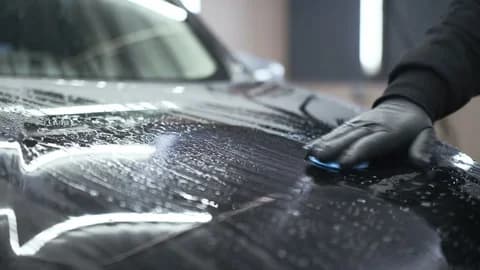
Flying rust is one of the most underrated forms of paint contamination: tiny iron particles that embed in your paint and wheels and start to rust. Plain washing does not remove them, but a chemical iron remover dissolves them so you can rinse them away. This guide explains what flying rust is, how the removers work and which one to choose. You will find all the products in the flying rust and fallout category.
What is flying rust and fallout
Flying rust, also called fallout, comes from brake dust, rail dust and industrial deposits. Braking releases red-hot iron particles that burn into the paint and wheels. There they oxidise and form small rust spots. You feel it as roughness over the paint, even though it looks clean. Important: this is surface contamination, not the same as structural rust where the metal itself rusts through. For flying rust you use an iron remover; rusted-through metal needs a rust treatment.
How iron removers work
An iron remover contains an active ingredient that reacts with the embedded iron particles and makes them water-soluble. During that reaction a striking red-purple colour appears, the familiar bleeding, which shows exactly where the contamination sits. There are acid-free and acid-based variants; most modern detailing removers are acid-free and therefore safe on paint, glass and most wheels. Always work on a cool surface and rinse well.
Which remover to choose
We sell several iron and flying-rust removers, each with its own strength. The table below helps you choose.
Product | Character | Best for |
|---|---|---|
Wheel cleaner and de-ironizer in one | Wheels and stubborn brake dust | |
Acid-free flying-rust remover (pH 7.5) | Paint and wheel, safe and mild | |
Iron and fallout remover | Pre-cleaning paint and wheel | |
Non-alkaline, pH-balanced (pH 5.5-7) | Paint, spreads easily | |
Acid-free light pre-cleaner | Light fallout on paint and glass |
How to tackle it step by step
Wash. Wash the car thoroughly with the two-bucket method so loose dirt is gone.
Spray the iron remover. Spray the remover on a cool surface, in the shade, over paint or wheel.
Let it react. Wait until the red-purple colour stops increasing and do not let it dry.
Agitate and rinse. Agitate stubborn spots lightly with a soft brush and then rinse thoroughly under pressure.
Clay and protect. If bonded contamination remains, use clay, and finish with a wax or sealant.
See the reaction in action
In this official Shiny Garage video you see how an iron remover reacts on the paint and bleeds red-purple. That is how you recognise exactly when the product is doing its work.
Common mistakes to avoid
Working in the sun or on a hot wheel. The product dries too fast and works less well; always work cool and in the shade.
Letting it dry. Rinse before the remover dries in, otherwise you get streaks.
No gloves or ventilation. Iron removers can give a sharp smell and skin reaction; work ventilated with gloves.
Too long on delicate wheels. Test on a hidden spot first on chrome, polished or bare aluminium.
Confusing it with a rust converter. An iron remover is for flying rust on paint and wheel, not for treating rusted-through metal.
Paint, wheel or glass
On paint a treatment once or twice a year is usually enough. Wheels pick up brake dust faster and need doing more often. On glass an iron remover works the same way, although the contamination is less stubborn there. On all surfaces: work cool, do not let it dry and rinse well.