
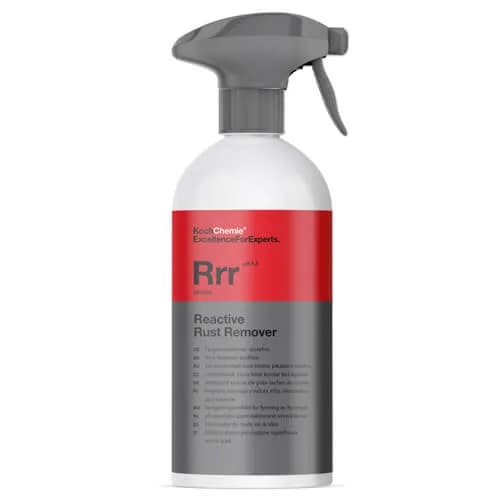
Koch Chemie RRR Reactive Rust Remover lifts iron fallout, baked-on brake dust and other iron particles off your paint, glass and wheels. You spray it on neat, wait a few minutes while the product turns purple on the iron particles, and rinse thoroughly. RRR is acid-free and, with a pH of 7.5, a lot milder than an acidic rust remover. You will find Koch Chemie RRR Reactive Rust Remover in the shop.
What RRR does
Fine iron particles from brakes and rails float in the air; they settle on your paint and wheels and start to rust. That is iron fallout: you feel it as a rough layer and you see small brown specks. RRR reacts with those iron particles and converts them into a soluble form that you rinse away. The purple discolouration you see is the reaction itself: where it turns purple, iron is dissolving. Koch Chemie states the product is acid-free, which makes it safer for paint and wheels than a classic acidic rust remover.
How to use it
Cool, clean work area. Work on cool paint or a cool wheel in the shade, not on a hot wheel or in direct sun, and rinse off coarse dirt first.
Spray on neat. Spray RRR undiluted onto the surface, evenly and without leaving pools.
Wait for the reaction. Let it dwell about 3 to 6 minutes; the product turns purple where it meets iron. Do not let it dry.
Agitate and rinse. Work stubborn spots with a soft brush or sponge, then rinse everything thoroughly with plenty of water.
Tips for the best result
Work panel by panel or wheel by wheel, so the product does not dry anywhere before you rinse.
After the dwell, rinse generously with plenty of water, also in the spokes and seams where the reaction collects.
Wear gloves; RRR is mild on your paint, but less so on your skin.
Work outdoors or well ventilated, as the product can smell sharp during the reaction.
What to watch out for
RRR is suitable for painted surfaces, glass and wheels. Test sensitive or polished surfaces such as bare aluminium on an inconspicuous spot first for material compatibility. Do not use it on hot surfaces and do not let it dry. It is a decontamination step, not a weekly product: you use it when the paint feels rough or the wheels show brown specks, often just before claying or coating.
Iron fallout or loose wheel dirt
If the paint still feels rough after washing, there is often other bonded dirt on it besides iron; you remove that with a clay bar. For the wheels themselves a dedicated wheel cleaner often works faster on the daily dirt. For that, read the guide cleaning wheels without damage. You will find more products against iron fallout in the iron fallout category.