
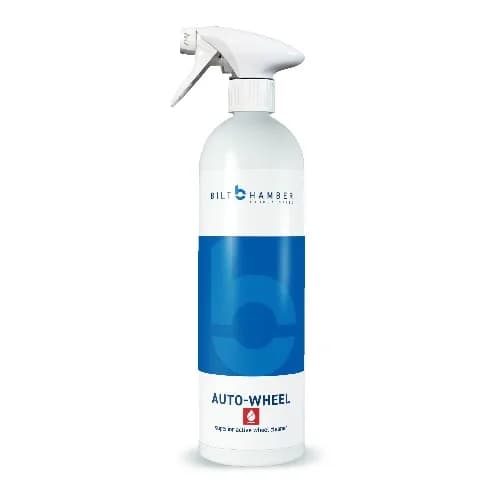
Bilt Hamber Auto-Wheel is a non-acid, non-alkaline wheel cleaner that reacts with the iron particles in brake dust. You spray it on neat onto a dry wheel, wait until it turns from clear to deep red and then rinse off. Because it is neither acidic nor alkaline, it is safe on almost every type of wheel. You will find the Bilt Hamber Auto-Wheel in the shop.
What Auto-Wheel does
Brake dust consists largely of red-hot iron particles that burn into the wheel and start to rust. Auto-Wheel reacts with those oxidised particles and makes them water-soluble so they rinse away. The colour change from clear to red shows exactly where the contamination sits and when the cleaner is doing its work. Bilt Hamber states that Auto-Wheel is suitable for alloy, aluminium and steel wheels, and explicitly confirms it is also safe on diamond-cut wheels.
How to use it
On a dry wheel. Work on a cool, dry wheel, not in full sun.
Spray radially. Spray Auto-Wheel neat from the centre outward, so you spare the centre cap.
Let it react. Wait one to five minutes until the colour has turned from clear to red; only brush on stubborn dirt.
Rinse off. Rinse the wheel thoroughly with a hose or pressure washer.
Auto-Wheel or Korrosol
Bilt Hamber makes Auto-Wheel and Korrosol for different surfaces. Auto-Wheel clings to a dirty, vertical wheel; Korrosol is for paintwork and spreads more easily. The table puts them side by side.
Feature | Auto-Wheel | Korrosol |
|---|---|---|
Made for | Wheels (vertical, dirtier) | Paintwork |
Behaviour | Clings on | Spreads out |
Colour change | Clear to red | Purple |
Apply on | Dry wheel | Cool paint |
What to watch for
Avoid spraying directly on brake calipers and pads where possible; if it happens, rinse it off. Work on a cool wheel and do not let the product dry. For a wheel that mainly catches brake dust and daily dirt without an iron reaction you can also look at the Koch Chemie MWC Magic Wheel Cleaner. You will find more wheel cleaners in the wheel cleaners category.