
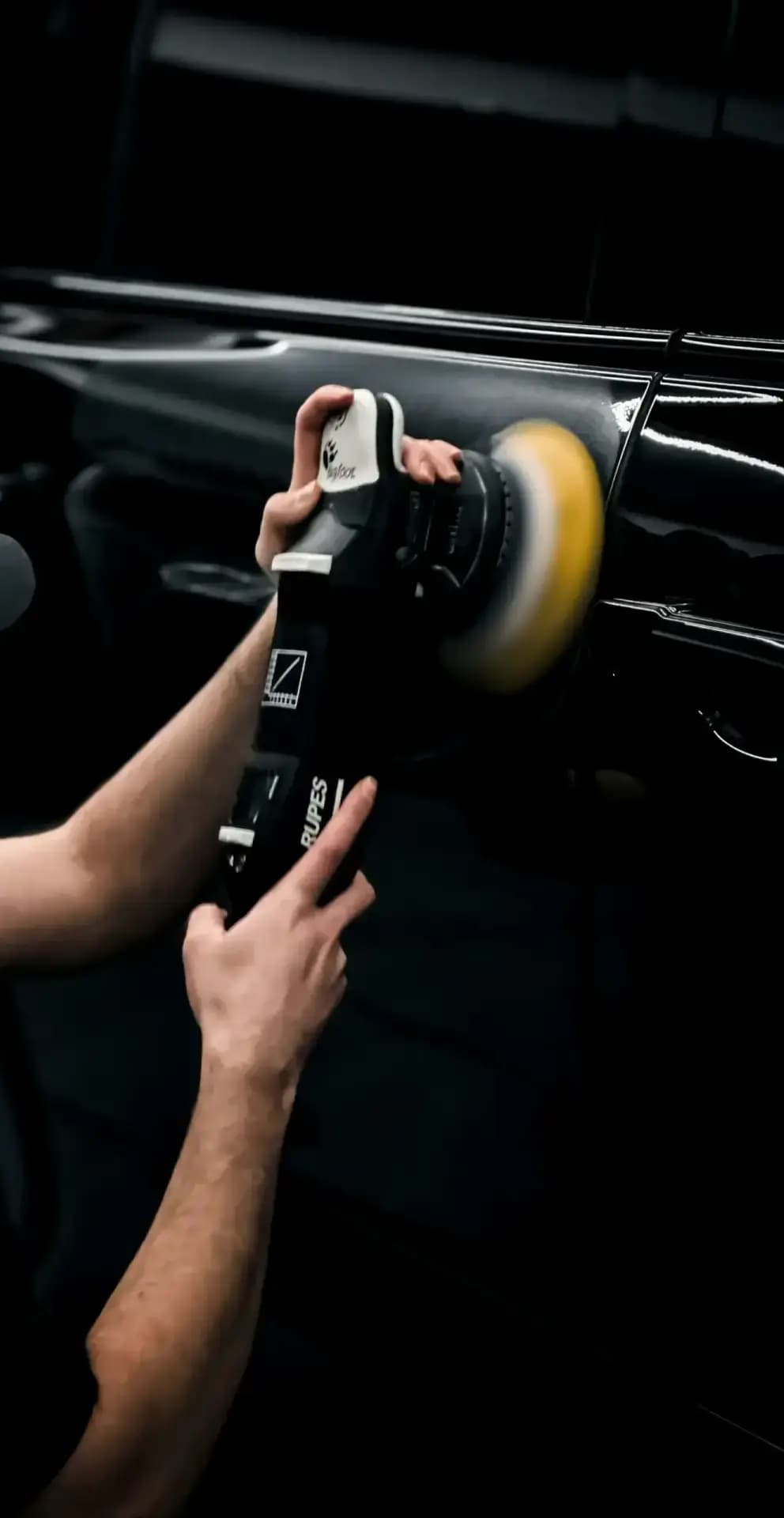
Which Liquid Elements polisher you choose comes down mainly to the throw: 8 mm (T2000 V4) is the calmest for a first machine, 10 mm (T3200) is the middle ground, 15 mm (T4200) is fastest on large panels and the A1000 V4 is a small cordless machine for details. The three mains-powered models all have a 125 mm backing plate and an 8 metre cable, so the difference lies in throw, power and the kind of job.
What to look for in a polisher
A dual-action machine spins the pad and moves it in a small circle at the same time. The size of that circle is the throw. A larger throw lets the pad cover more paint per minute, a smaller throw gives more calm and control, especially on narrow areas and curved panels.
Throw: 8 mm for control, 10 mm for a good balance, 15 mm for speed on bonnet, roof and doors.
Backing plate: 125 mm on the T models, 38 mm on the A1000 V4. Your pads have to match.
Power: 710 W, 750 W or 950 W. More power keeps the pad moving better under pressure.
Cable or battery: the T models have an 8 metre cable, the A1000 V4 runs on two 12V batteries.
The Liquid Elements polishers compared
Product | Throw and backing plate | Best for |
|---|---|---|
8 mm, 125 mm | First machine, calm and manageable work | |
10 mm, 125 mm | All-round: beginners who want to grow and experienced users | |
15 mm, 125 mm | Fast work on large panels, correction and finishing | |
3 mm, 8 mm or rotary, 38 mm | Headlights, door handles, mirrors and other details |
Machine by machine: what it is and who it suits
The T2000 V4 is the entry model of the T range: 710 W, an 8 mm throw and a 125 mm backing plate. The small throw makes the pad easy to steer, so you learn the movements without the machine taking over. It comes with a storage bag.
The T3200 has 750 W and a 10 mm throw. It suits beginners and people with some experience, and you set the speed yourself. If you might want more than a first test panel within a year, this is the machine that grows with you.
The T4200 has 950 W and a 15 mm throw. That throw lets the pad cover more paint per minute, so both compounding and finishing go faster on large panels. A carry case is included, handy if you travel with your kit.
The A1000 V4 runs on two 12V batteries, each good for about 45 minutes of polishing, with a charge time of around 60 minutes. You switch between 3 mm orbital, 8 mm orbital and rotary, and set the speed from 2,500 to 6,000 rpm. It is meant for places a big machine cannot reach, such as headlights (see our guide to polishing headlights).
Add pads and polish
A good machine only pays off with the right pad. For the 125 mm backing plate you could work with 130 mm pads, such as the D-CON Delta Fiber Pro Medium Yellow for moderate defects like swirls and holograms and the Koch Chemie Polish Sealing Pad for applying sealant or wax after polishing. More choice sits in polishing pads and polishers.
Which one suits you
You are polishing for the first time and want control: the T2000 V4. Also read our guide to the best polisher for beginners.
You want one machine for your own car and friends' cars: the T3200.
You polish large or many cars and want pace: the T4200.
You need to do headlights, mirrors or door edges: the A1000 V4.
You want to understand the technique first: read polishing your car and removing swirls.