
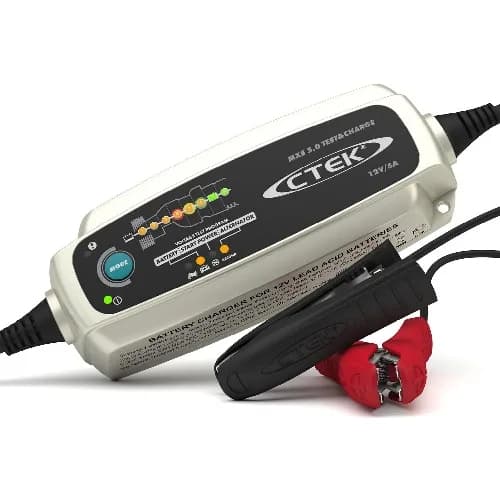
The CTEK MXS 5.0 Test & Charge is a fully automatic battery charger for 12V lead-acid batteries from 1.2 to 110 Ah, with a test function for battery and alternator. You attach the clamps to the battery, plug it in, pick a programme and let the charger work. This guide shows how to connect the CTEK MXS 5.0, which programme suits which battery and how to leave it connected for longer periods.
What the CTEK MXS 5.0 is and what it does
The CTEK MXS 5.0 charges 12V lead-acid batteries of the wet, MF, Ca/Ca, AGM and gel type, fully automatically in a connect-and-forget way. The Test & Charge version we sell charges the battery and at the same time tests the battery voltage, the starting power and the performance of your alternator with three test programmes.
A temperature sensor comes with the unit. It matches the charging voltage to the temperature in your garage. The charger is IP65, so it handles splashes and dust, it works spark-free, and CTEK gives a 5-year warranty.
Key specifications of the CTEK MXS 5.0
Feature | Value |
|---|---|
Input | 220 to 240 VAC, 50 to 60 Hz, 1.1 A |
Output | 14.4 / 14.7 / 15.8 V, 5.0 A |
Battery capacity | 1.2 to 110 Ah |
Suitable for | 12V lead-acid: wet, MF, Ca/Ca, AGM and gel |
Start voltage | From 2.0 V |
Programmes | Smaller battery, normal battery, cold weather and Recond |
Test function | Battery voltage, starting power and alternator |
Ambient temperature | +5 to +50 °C |
Protection | IP65, spark-free, reverse polarity protection, short-circuit proof |
Warranty | 5 years |
How to do it
Check the battery and the surroundings. Make sure it is a 12V lead-acid battery from the table above and put the charger on a stable spot with fresh air, away from heat sources.
Clamps on the battery. Red goes on the positive terminal, black on the negative terminal. If the battery is in the car, put the black clamp on a bare metal point of the chassis, away from the battery and the fuel lines. Tip: the charger is not plugged in yet, and you wiggle the clamps until they grip firmly, because poor contact triggers an error light.
Plug in the mains. Clamps first, plug second. The indicator lights show whether the connection is right.
Choose the programme. For an ordinary battery, pick the normal battery programme. A small battery from a motorbike or scooter needs the smaller battery programme, and in cold weather you use the cold weather programme. An AGM battery, as fitted to many Start/Stop cars, is among the suitable types: check the manual for which programme to pick. Tip: Recond is for a deeply discharged battery and you only use it when needed.
Let the charger work. It runs through its own charging programme, including desulphation, charging and then float/pulse maintenance.
Test the battery and the alternator. With the three test programmes you measure the battery voltage, the starting power and what your alternator does. That shows whether a slow start comes from the battery or the alternator. Tip: always test a car that starts slowly first, before you buy a new battery.
Disconnect in the right order. Plug out of the mains first, then the black clamp and the red one last. Tip: if you leave the charger connected for a long time, for example over winter, the float/pulse maintenance keeps the battery topped up without overcharging it.
Common mistakes and tips
Plugging in the mains before the clamps are on the battery. Always start with the clamps.
The wrong programme for an AGM battery. Check which type your battery is and choose accordingly.
Dirty or loose battery terminals. Clean them and fit the clamps firmly, and the charger starts faster and more reliably.
Charging a lithium vehicle battery with a lead-acid charger. The MXS 5.0 is for lead-acid. For lithium look at the NOCO Genius, which has its own lithium mode.
What to combine with the CTEK MXS 5.0
If you need a smaller battery charger or a lower charging current, the CTEK MXS 3.8 is a compact second charger.
A motorhome or boat with a starter and a service battery tops up on the move with the CTEK D250SE. For motorhome care, read washing and polishing a motorhome.
For a car that always sits in the same place, the NOCO Genius2D is a charger you mount permanently.
In case you get stranded anyway, the Projecta IS1220 fits in your boot. How to choose between a charger and a booster is covered in choosing a battery charger or jump starter.
More chargers and boosters are in the category jump starters and batteries.