
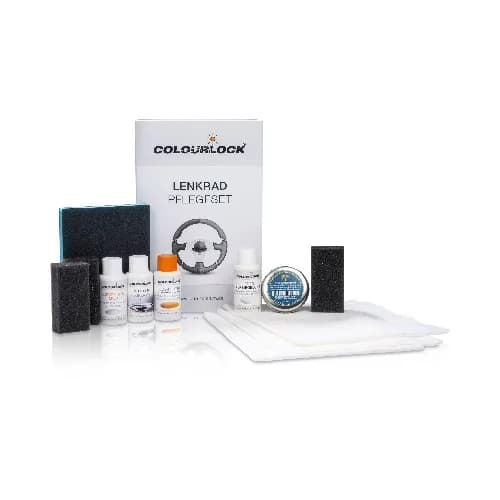
You restore a worn, faded or dull black leather steering wheel with the Colourlock Leather Steering Wheel Repair Kit: clean with foam first, lightly sand rough spots and degrease, then colour in thin layers with Leather Fresh and finally seal with Leather Shield. That is the core of a Colourlock steering wheel repair, and below you can read how to handle each step.
The kit is made for black steering wheels with visible wear or scratches. If your wheel is a different colour, this set is not the right choice. Cracked or badly damaged leather is outside what the kit covers and needs professional repair. In the workshop we see that the preparation decides the result: clean and degrease properly and you get an even colour layer that bonds well.
What is in the Colourlock steering wheel repair kit
The kit has ten parts that together make a complete treatment. These are the key facts:
Part | Quantity | What it does |
|---|---|---|
Leather Cleaner mild | 100 ml | Cleans the leather |
100 ml | Degreases the surface so the colour bonds | |
Leather Fresh | 100 ml | Re-colours the black leather |
Leather Shield | 100 ml | Seals the new layer |
Elephant Leather Preserver | 15 ml | Re-nourishes older leather |
Sanding pad | 1 | Evens out rough spots |
Foamer bottle | 1 | Turns the cleaner into foam |
Viscose cloths | 2 | For wiping off and finishing |
Cleaning and application sponges | 3 (small) | For cleaning, colouring and sealing |
2 | Keep your hands clean |
How to do it
Prepare. Park the car in the shade or in a garage, put on the gloves and tape off what you do not want to treat, such as the airbag edge, the buttons and the dashboard around the wheel. Turn the wheel to a position where you can reach all the leather.
Clean. Fill the foamer bottle with Leather Cleaner mild and apply the foam to a sponge, not directly to the wheel. Clean the whole wheel, then wipe off the dirt and residue with a lightly dampened cloth. Let everything dry completely and repeat if needed. Tip: include the underside of the rim, where your hand leaves the most oil.
Sand. Run the sanding pad gently over the rough spots so the surface evens out. Tip: do not press hard, the aim is to level the surface, not to remove material.
Degrease. Spread a few drops of Degreaser over the leather with a cloth and let it air dry thoroughly. Tip: check adhesion by pressing a piece of masking tape onto the leather and peeling it off. If the tape sticks firmly, the surface is ready.
Colour. Shake Leather Fresh well, dab it onto the leather with a sponge and never apply it straight from the bottle. Work in several thin layers and dry each layer with a hair dryer. Tip: take extra care at seams where two colours meet. If the colour looks uneven, you can sand lightly and colour again.
Seal. The leather must be dry for at least 24 hours and free of residue before you seal. Put a few drops of Leather Shield on a sponge, spread it thinly without rubbing hard and dry it with the hair dryer. Tip: one application is usually enough, repeat only for very delicate or highly absorbent leather.
If the wheel is older and has gone dull from heavy use, give it a pass with the Elephant Leather Preserver before sealing. Put a small amount on a cloth, spread it evenly without pressing, let it soak in overnight and polish it off the next day. If the leather does not need re-greasing, go straight to sealing.
Common mistakes and tips
Skipping the degreasing. A greasy surface is the most common mistake, and the easiest one to avoid.
Too much product at once. Build up in thin layers and dry each one, and the result stays even.
Sealing too early. Give the leather time to dry after colouring before the Leather Shield goes on.
Not masking and not testing. Tape around the edges keeps the rest of the interior clean, and a trial on an inconspicuous spot shows how the leather reacts.
What to combine the kit with
If you want to maintain the wheel yourself afterwards, the Colourlock Protective Leather Lotion suits smooth leather well: it nourishes without a greasy film. For a larger quantity of leather grease you can use the Colourlock Elephant Leather Preserver, explained in our guide Using Colourlock Elephant Leather Preserver. For regular cleaning of the rest of the upholstery the Colourlock ALC Allround Leather Cleaner is a handy choice, and you will find all leather products in the leather cleaning category.
For more on the whole leather interior, read Clean, condition and repair leather: the complete guide. If your wheel is in decent shape and you only want it black and crisp again, restoring a leather steering wheel helps. For a different brand and method, read the guide to the Leather Expert steering wheel restoration kit.