
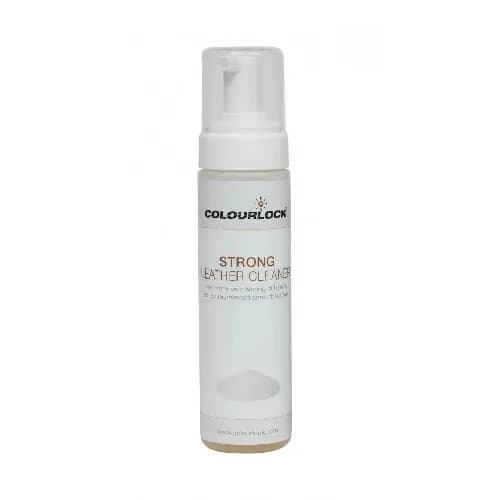
The Colourlock Strong Leather Cleaner is a pH 8 foam cleaner for leather that is visibly dirty: a shiny steering wheel, greasy seat bolsters, dark armrests. You dispense the foam with the foam pump onto a brush or sponge, work it in and wipe it off with a slightly damp cloth. For light soiling, reach for the mild version instead.
Below you will find which leather it is made for, how to apply it and what to do afterwards. It is based on our workshop experience and on what the manufacturer says about the product.
Key facts
Item | Detail |
|---|---|
Type | Foam cleaner, via foam pump |
pH value | 8 |
Contents | 200 ml and 1000 ml |
Suitable for | Pigmented and coated smooth leather, including Cool Leather, SRT Leather and nappa leather |
Not for | Aniline, suede and nubuck |
Use | Car, furniture, bags, shoes |
Colourlock strong leather cleaner or mild: which one?
Keep the strong cleaner for leather that is properly dirty. The Strong lifts grease, body oils and dried-in dirt from the surface. You see that most on the steering wheel, the driver's seat bolster and the armrest. If there is just a film of dust and skin oils, the mild version is enough and you can use it more often.
So use the Strong when it is needed, not as a weekly routine. For regular care the Colourlock ALC Allround Leather Cleaner or the mild cleaner is the gentler choice.
Check the leather type. The strong cleaner is for pigmented, coated leather, like most car interiors. It is not meant for absorbent leather such as aniline, suede and nubuck. Not sure what you have? Put a drop of water on a hidden spot: if it soaks in straight away and darkens the leather, it is not pigmented leather and you should not use this product.
How to do it
Dust first. Remove loose dirt and grit with a dry microfibre cloth or vacuum the seams. Grit that you rub around scratches the top coat.
Test a hidden spot. Do this under the seat or on the inside of a side panel. Once dry, check that colour and feel are unchanged.
Shake and foam. Shake the bottle, pump the foam onto a brush or sponge and never straight onto the leather. That way you decide how much moisture reaches the leather.
Work in sections. Take one seat base, bolster or steering wheel quarter at a time and use circular movements. A soft leather brush, such as the Koch Chemie Colourlock Leather Brush, reaches stitching and grain that a sponge misses.
Wipe off. Remove the dirty foam straight away with a clean, slightly damp microfibre cloth and rinse the cloth as you go. A greasy steering wheel sometimes needs a second pass.
Let it dry. Give the leather time to dry before you carry on. Looks more matt than before? That is normal, because the grease that gave the shine is gone.
Care for it. Cleaning is the first step. Feed and protect the leather with a leather care product, for example the Colourlock Protective Leather Lotion.
Common mistakes and tips
Do not spray the foam onto the leather. Always brush or sponge first, then leather.
Do not work too wet. Damp is enough, soaked leather takes longer to dry.
Do one seat at a time. That way the foam does not dry in before you wipe it off.
Do not expect colour restoration. The cleaner removes dirt but does not repair worn colour or scratches. For that you need colour and repair products, see our guide on restoring a leather steering wheel.
What to combine it with
A leather brush for seams and grain: Koch Chemie Colourlock Leather Brush (already mentioned in step 4).
A feeding finish, such as Colourlock Elephant Leather Preserver for smooth and greasy leather, or the lotion above.
A sealant as the last layer: Koch Chemie Finisher LeatherLock.
You will find more interior products in the leather cleaning category. For the whole approach from cleaning to repair, read clean, condition and repair leather and our guide to the mild Colourlock cleaner. For leather grease there is a separate guide on the Elephant Leather Preserver.
Does the interior still smell of smoke or damp even when the leather is clean? Then the smell is often not in the leather. An ozone treatment deals with that.