
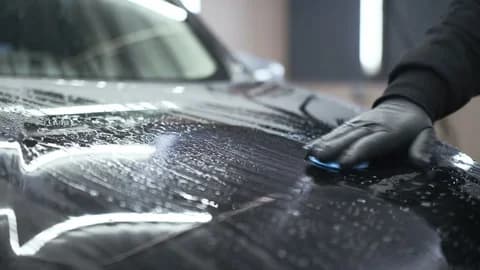
Tar and insect residue stick to your paint and can damage it over time. You remove them best separately, each with the right product. Tar spots you tackle with a solvent-based tar remover: apply, let it dwell briefly and wipe off gently. Insects you soften with an alkaline insect remover and then wipe or rinse away. Important for both: let the product do the work and do not rub anything off dry, because then you grind the hard particles across the paint. Do this after washing, on cool paint in the shade, and restore the protection afterwards.
Why tar and insects cause damage
Tar is bitumen that splashes onto your paint from fresh asphalt, usually on the lower panels and behind the wheels. It sticks strongly, and if you try to rub it off dry, you drag the hard particles along and pull scratches. Insect residue is acidic and contains proteins that harden; the longer it stays on, especially in sun and heat, the more it can etch into the paint layer. So you remove both preferably quickly and with a product that first dissolves or softens the bond, so you can wipe without pressure.
Removing tar
For tar, adhesive residue and rubber marks you use a solvent-based tar remover. Apply the product to the spot, let it dwell briefly so the tar dissolves, and wipe it away with a clean microfiber towel. Repeat on stubborn spots instead of rubbing harder. Because a tar remover works on solvent, it also removes your wax on that spot, so wash and re-protect the area afterwards. A reliable choice is the Koch Chemie Eulex, which quickly dissolves tar, glue and tree sap and is safe on paint, glass and metal.
Removing insects
Insect residue you tackle with an alkaline insect remover that loosens the proteins. Spray the product onto the dirty spot, usually the front bumper, hood and mirrors, and let it dwell for a moment so the residue softens. Then wipe or rinse it away with a soft cloth or insect sponge, without scrubbing. If it has been on for a while, let the product dwell a little longer and repeat instead of scrubbing. A nice choice is the D-CON Fly Bug insect remover, which loosens the residue so you can remove it without rubbing.
How to tackle it
Wash the car first so you are left with only the stuck-on tar and insect residue. Then work on cool paint in the shade, not in full sun.
Treat the tar spots with a tar remover. Apply the product, let it dwell briefly and wipe the dissolved tar away with a clean microfiber towel. Repeat on thick spots.
Treat the insect residue with an insect remover. Spray it on, let it dwell until the residue is soft and wipe or rinse it away with a soft cloth or insect sponge, without pressure.
Rinse the treated areas and dry them. Because a tar remover removes your wax on that spot, restore the protection afterwards with a wax, sealant or ceramic spray.
Prevention is easier than removal
A car with a good wax or ceramic coating is far easier to keep clean. Tar and insects stick less hard to smooth, protected paint, so you often get them off with little effort at the next wash. Washing regularly and protecting in time therefore saves you a lot of work. If you drive a lot of motorway during insect season, rinse the front as soon as possible so the residue does not get time to harden.
See all tar removers and insect removers, and also read how to remove bird droppings and tree sap.