
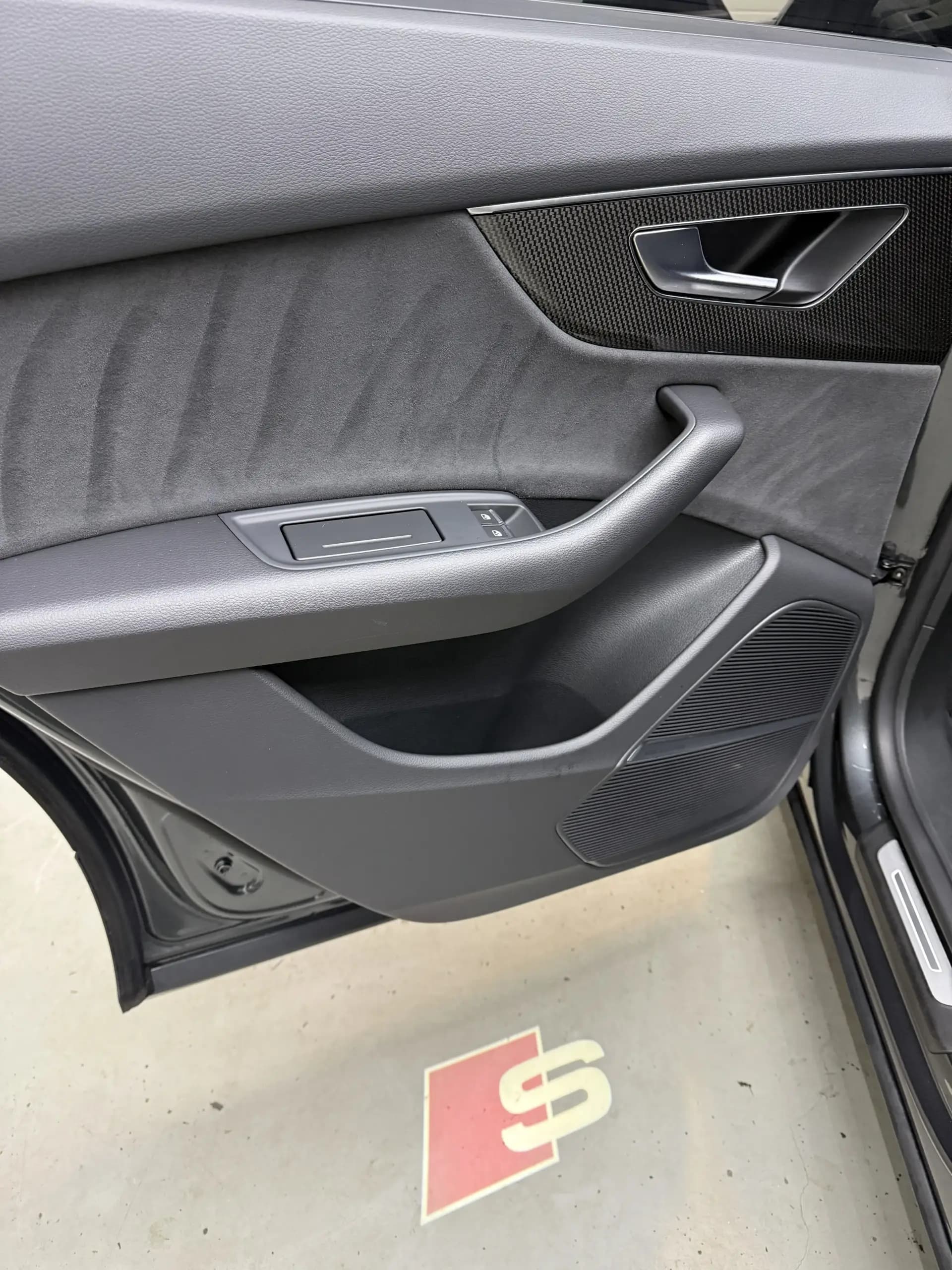
A Tornador is a compressed-air cleaning gun: the air from your compressor turns the cleaning fluid into a fine mist that spirals into seams, vents and upholstery. To use a Tornador you need a compressor that delivers enough air, a diluted cleaner in the reservoir and a cloth or vacuum nozzle to lift away the loosened dirt straight away.
What does a Tornador cleaning gun do?
A sponge or cloth cannot reach into an air vent or the seam of a seat. A Tornador can: the airflow carries the fluid to places your hand cannot get to and blows dirt, sand and crumbs loose. The gun works on plastic, rubber, vinyl, fabric and upholstery. That is why we use it on every interior for the dashboard, door cards, seat seams, footwells and vents.
Which compressor do you need for a Tornador?
As a guideline the manufacturer gives a working pressure of roughly 6 to 8 bar and an air output of at least about 250 to 300 l/min, supplied as a steady airflow. For the Tornador Classic Z-010 RS the stated consumption is about 270 l/min at 7 bar, with best performance from 8 bar. It suits 2.2 kW, 240 V piston compressors. For the Tornador Black Z-020S the manufacturer likewise states about 270 l/min and a 2.2 kW, 240 V piston compressor.
In practice, a small compressor with a small tank has to top up quickly. As soon as the pressure drops, the mist gets weaker. Let the pressure recover before you carry on, and when choosing a compressor look at the air output in litres per minute, not just the maximum pressure.
Which Tornador model suits which job?
Model | What it is for |
|---|---|
The original gun with a built-in fluid tank. For dashboards, door cards, seat upholstery, vents and headlinings. | |
Professional model with a rotation system and ball bearings. For anyone who works on several vehicles every day. | |
Blowing and vacuuming in one movement, connected to your own vacuum. For seat seams and the engine bay. | |
A 2 metre hose that works from a jerry can or bucket instead of the reservoir. For long jobs. |
How to do it
Vacuum first. Remove loose dust, sand and crumbs before any liquid goes in, or you turn them into mud.
Choose and dilute the cleaner. An odourless option that is Tornador-compatible is D-CON Crystal Clear APC, diluted 5:1 (water:product) for interiors. Mix the fluid beforehand in a measuring jug, not in the reservoir itself, so the ratio is right.
Fill the reservoir and set the pressure. Do not fill to the brim; close the cap firmly. Start at the lower end of the pressure range and turn up if the dirt does not release. More pressure is not automatically better, it mainly changes how much liquid ends up on the upholstery.
Work from top to bottom. Start with the headlining and dashboard, then door cards, seats and finally the floor. Use short bursts, holding the gun a little way from the surface. On upholstery you spray lightly and several times rather than wetting it once. Keep the headlining and moisture-sensitive parts extra dry.
Lift the dirt straight away. Wipe with a clean microfibre cloth or vacuum up the loosened dirt, for example with the Beast attachment. If you leave it, it dries back onto the spot. A soft brush such as the Tornador Detailing Brush Soft helps on stubborn edges.
Clean the gun after use. Run clean water through the gun and pull the trigger so no cleaner dries inside the mechanism. For maintenance there is Tornador Clean, diluted 1:10, for the Classic and the Black.
Using a Tornador on upholstery, seams and vents
On fabric upholstery you always work with a light mist and test on an inconspicuous spot first, especially on light or coloured fabric. On seams and stitching, hold the gun at an angle so the dirt is blown out of the seam rather than deeper into it. On air vents work in short bursts with a cloth or vacuum nozzle right behind, otherwise the dirt ends up further along the dashboard.
For a whole interior, also read our guides on cleaning an interior without damage and cleaning car seats and upholstery. For choosing the cleaner itself, the guide using D-CON Crystal Clear APC is a good next step. You will find all parts and accessories in the compressed air and Tornador category.
Common mistakes with a Tornador
Too little air. A compressor that keeps having to top up gives a weak mist. Check the air output in l/min.
Working too wet. Spray lightly and more often, especially on upholstery and headlinings.
Leaving the dirt behind. The Tornador loosens, you lift it away with a cloth or vacuum nozzle.
Too strong a mix in the reservoir. Mix beforehand and follow the cleaner manufacturer's ratio.
No maintenance. Clean the gun after use and replace worn parts, such as the nozzle or cap, with original parts.