
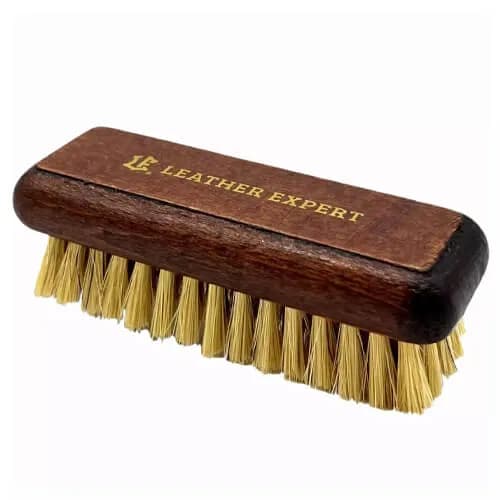
You use a leather brush to lift dirt out of the grain and seams of car leather, where a cloth only glides over it. With the Leather Expert Leather Brush you brush away the loose dirt first and then work in a leather cleaner. It is the fixed first step in our leather care, and the reason a leather brush for a car interior gets seats so much cleaner than a cloth alone.
Leather is not smooth plastic. It has a fine grain, stitched seams and creases where sand, dust and crumbs settle. A cloth smears that dirt around, a brush pulls it out. That is why we start every leather interior with a brush, before any cleaner comes near it.
Why use a leather brush and not a cloth?
A microfibre cloth follows the surface but does not get deep into the grain. Sand and dust sitting in the creases also get dragged across the leather as soon as you press down. The soft, natural bristles of the Leather Brush reach into seams, creases and the fine leather texture. According to the manufacturer the natural bristle is very gentle, and the compact size (11 cm long) sits comfortably in the hand.
The softness matters. The brush is made for cleaning leather. Still, use light pressure, especially on delicate leather. A wheel brush or stiff scrubber has no place here.
The Leather Brush at a glance
Feature | Leather Expert Leather Brush |
|---|---|
Bristles | Natural hair, soft |
Handle | Comfortable shape, 11 x 4 x 3.5 cm |
Use | Loosening dirt before leather cleaning |
Suitable for | Leather |
Brand | Leather Expert |
How to use a leather brush, step by step
Vacuum first. Take the coarse dirt out of the seams and creases with a vacuum. Tip: use a soft brush head, not a bare nozzle that scrapes across the leather.
Brush dry. Go over the leather with light pressure and short, calm strokes, especially along stitched seams and edges. This frees the sand and dust the vacuum left behind. Tip: work panel by panel so you never pass over dirt you have already loosened.
Apply the cleaner. Spray the cleaner onto the brush or a small section of leather, not in a big puddle. The Shiny Garage Leather Cleaner Soft is one option. Tip: with a pH-neutral cleaner, a lightly damp surface works best.
Brush it in. Work the cleaner in with small circles and let the brush do the work. The bristles carry the cleaner into the grain and lift the dirt out. Tip: do not press harder, let the cleaner work.
Wipe off. Wipe the loosened dirt and cleaner away straight away with a clean, dry microfibre cloth. Fold the cloth often so you do not put dirt back.
Condition. Once the leather is dry, apply a conditioner or lotion such as the Colourlock Protective Leather Lotion. Tip: after cleaning the pores are open and the care product soaks in best.
Clean the brush. Rinse the bristles briefly with clean water after use and let the brush air dry bristles down. That keeps the bristles in shape for next time.
Common mistakes with a leather brush
Cleaner first, dust later. Sand gets wet and grinds into the leather. Always brush dry first.
Too much cleaner. A wet seat dries unevenly and leaves marks. A few sprays on the brush is enough.
A brush that is too stiff. Use a soft leather brush for leather and keep stiff brushes for tyres and mats.
One brush for everything. A brush that has been on wheels or in the engine bay does not belong on your seats. Keep a separate brush for leather.
Skipping the wipe. The dirt you loosen has to leave the seat. Take it off panel by panel with a dry cloth.
What to combine the leather brush with
The brush is the first step, cleaning and care follow. If you want everything to hand, the Leather Expert Interior Cleaning & Care Kit is a ready-made combination of cleaner and conditioner. If you want a second brush for tight corners, look at the Koch Chemie Colourlock Leather Brush, which is compact enough for stitched seams and cushion edges.
You will find more brushes for other jobs in the brushes category. For the cleaning and care itself, everything is in leather care.
Want the whole approach in one overview? Clean, condition and repair leather: the complete guide walks through every step. How to feed the leather after cleaning is covered in Using Leather Expert Leather Conditioner. And the wider approach for seats, door panels and plastics is in Cleaning your interior without damage.