
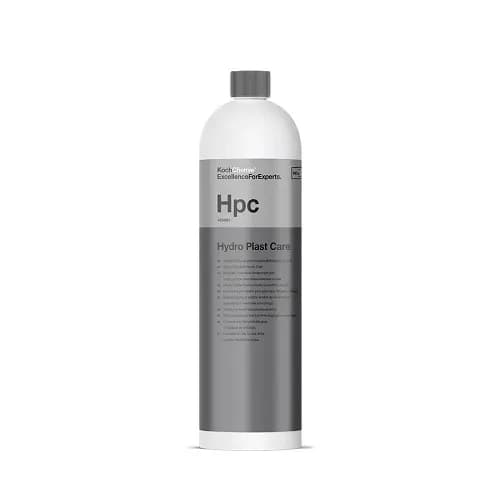
You use Koch Chemie HPC Hydro Plast Care for exterior and interior plastic care: dilute the concentrate with water, apply it thinly to a clean, dry surface and choose the gloss yourself. Diluted 1:1 it gives high gloss. At 1:4 you get the original factory finish. The Koch Chemie HPC Hydro Plast Care works on all plastics and rubbers, so on the dashboard, door panels, tyres, roof rails and door seals.
What makes HPC special is that one bottle gives you four different finishes, so you do not need a shelf of separate dressings. The formula is water-soluble and solvent-free, contains UV protection that slows yellowing and fading, and actively repels new dirt. It carries a vanilla scent, which makes working in a warm car much more pleasant.
Key facts about HPC Hydro Plast Care
Feature | Detail |
|---|---|
Content | 1 litre |
Type | Plastic and rubber care (concentrate) |
Dilution | 1:1, 1:2, 1:3 or 1:4 with water |
Solvent-free | Yes |
UV protection | Yes |
Scent | Vanilla |
Use | Interior and exterior |
Which dilution gives which gloss?
The dilution sets the gloss, not the number of coats: the more water, the calmer the finish. Only mix what you will use in one session.
Dilution | Gloss |
|---|---|
1:1 | High gloss |
1:2 | Medium gloss |
1:3 | Half-matt |
1:4 | Original factory finish |
How to do it
Clean first. Remove dust and dirt with a suitable cleaner and let the part dry completely. On a dirty or damp surface the result turns patchy. Our guide to cleaning the dashboard and interior plastics shows how.
Choose the gloss. Decide between high gloss, medium, half-matt or factory finish and mix the concentrate with water in that ratio. Shake or stir it so it is well mixed.
Test a small area. Start somewhere out of sight. You see straight away whether the gloss is what you want and can still change the dilution.
Apply thinly. Use an applicator sponge or a cloth, for example the Koch Chemie Interior Applicator Sponge. Work panel by panel and do not let product pool in seams and edges.
Spread evenly. Wipe in one direction so the layer is the same thickness everywhere. A thin coat is enough: a thicker one gives no extra protection, only more chance of streaks.
Let it dry and buff. Let it soak in briefly, then remove any excess with a clean microfibre cloth. Our article on microfibre cloths and GSM helps you pick the right one.
Exterior plastic care: what to watch
For exterior plastic care you choose the gloss yourself: 1:1 for a wet look, 1:4 if you want to keep it as matt as the factory left it. Weathered bumpers, roof rails, mirror housings and window trims take the product well, especially if you clean them thoroughly first. For heavily aged tyres and rubber you can start with a deep clean, for example with D-CON Tire Clean.
Stuck between two dilutions? Start with the weaker one and add a second thin coat if you like. That is easier than making a part that is too shiny look duller again.
Common mistakes and tips
Working on a dirty surface. Dust and old dressing under the layer give a patchy result. Clean and dry the part first.
Applying too thickly. A thin layer soaks in evenly and leaves fewer marks. Remove excess with a dry cloth.
Skipping the test. Try the gloss on an inconspicuous spot first, especially on a dashboard you see every day.
Working in full sun. In the shade the product dries more evenly and you get fewer streaks.
Using the same dilution everywhere. Not every part needs the same gloss. Pick the ratio that suits your taste for each part.
Leaving mixed product around. Make diluted product fresh and label your bottle so you know which ratio is inside.
What to combine HPC with
HPC is the finishing step of your plastic care, so the combination lies mostly in the prep and the application. For rubber on tyres and seals that you want to look more matt, the Koch Chemie GUF Gummifix Rubber Dressing fits. If you have more interior plastic to do, browse our plastic and dashboard category. If you only treat exterior plastic, our guide to Koch Chemie PSS Plast Star is a good addition.
Driving on black tyres and want a matching finish? Read how to apply tyre dressing.