
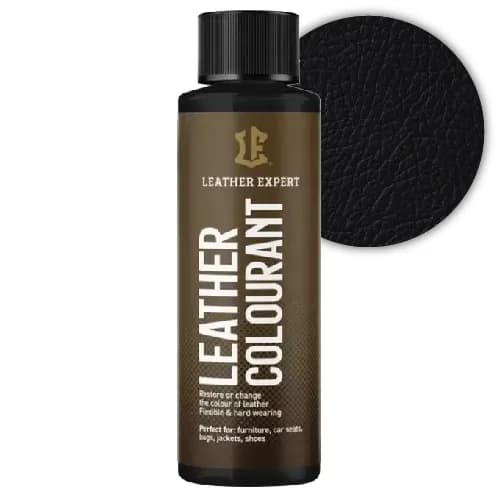
Leather Expert Leather Colourant is a water-based opaque leather paint you use to restore or completely change the colour of leather. The paint stays elastic and does not dry out, so it moves with the leather instead of cracking. The secret is in the preparation and in working thinly. You will find the Leather Expert Leather Colourant in the shop.
What the colourant does
Worn leather loses its colour where you touch it most: the side of the seat, the armrest, the gear lever. Leather Colourant lays a new, even colour layer over that. Because the paint is water-based and alcohol-free, it does not attack the leather, and because it stays elastic, the colour does not crack along. The colour layer only becomes truly durable once you seal it with a top coat.
The colour system: 49 colours
Leather Expert works with a colour chart of 49 standard colours that you can mix with each other, so you can approach almost any shade. If the standard colours do not get you there, Leather Expert offers a matching service: you send in a leather sample and they mix the colour to match. The overview below shows the colour families.
Colour family | Examples |
|---|---|
Black and white | 001 Black, 002 White |
Yellow and orange | 010 Yellow, 021 Orange |
Cream | 101 Ivory to 109 Cottage Cream |
Beige | 201 Beige, 203 Camel, 206 Kaschmir Beige |
Brown | 301 Light Brown to 312 Coffeehouse |
Grey | 401 Dark Grey to 406 Light Grey |
Red | 501 Orange Red to 504 Maroon |
Green and blue | 601 Green, 701 Heaven Blue, 704 Dark Blue |
Colourant or Colouring Balm
For a full recolour you use the colourant. If you only want to refresh the colour on absorbent leather, the Leather Expert Leather Colouring Balm is simpler: you rub it in and buff it off, without prep and sealing steps. The table puts them side by side.
Feature | Colourant (paint) | Colouring Balm |
|---|---|---|
Purpose | Full recolour | Refresh the colour |
Colours | 49, mixable | 12 |
Preparation | Clean, remove old layer, degrease | Clean only |
Application | Sponge or spray gun, thin layers | Sponge, rub in and buff |
Finishing | Top coat mandatory | None, optionally conditioner |
Best for | Worn or discoloured leather | Lightly faded leather |
How to use it
Prepare. Clean the leather, partially remove the old finish with the preparer and degrease with an alcohol cleaner.
Shake and apply thinly. Shake the paint well and apply it in thin layers with a sponge or spray gun, the first layer in circular motions.
Dry layer by layer. Let each layer dry completely before you apply the next.
Finish and let it rest. Seal the colour with a top coat and then leave the leather to rest for about five days.
Which gloss level to choose
The top coat you finish with sets the gloss. Leather Expert offers five gloss levels; choose the one that matches your original leather, from fully matt to high gloss.
Gloss level | Look |
|---|---|
Matt | No shine, natural |
Semi-matt | Very light sheen |
Satin | Soft, silky sheen |
Semi-gloss | Clear shine |
Gloss | High gloss |
See the recolouring in action
In this official Leather Expert video a worn leather seat is cleaned, repaired and recoloured. Note how thinly and evenly the paint is applied.
Which leather it suits
Leather Colourant is for natural, pigmented leather and faux leather. Do not use it on suede, nubuck or aniline; for those Leather Expert has a separate leather dye. Do not work on greasy or unprepared leather. The complete picture of cleaning, conditioning and repairing is in the guide cleaning, conditioning and repairing leather.